

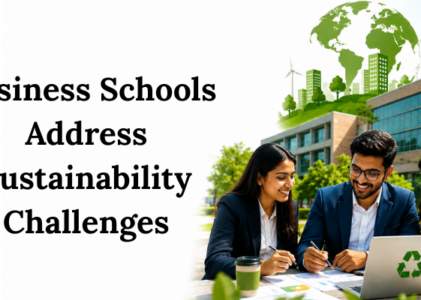
Sustainability has become a major focus for businesses worldwide as organizations face increasing pressure to balance profitability with environmental responsibility, social impact, and ethical governance. Climate change, resource scarcity, social inequality, and regulatory expectations have pushed companies to rethink traditional business models and adopt more sustainable strategies. Future corporate executives must thus acquire the information and abilities required to successfully handle sustainability issues.
Business schools play an important role in preparing students for this evolving business environment. They are increasingly integrating sustainability concepts into management education, leadership development, operations strategy, finance, and organizational decision-making. By addressing sustainability challenges through education, research, and industry collaboration, institutions help students understand how responsible business practices contribute to long-term success. Learning these concepts through a B School in Chennai helps individuals explore business ethics, sustainability strategies, responsible leadership, and corporate decision-making frameworks used in modern organizations.
Importance of Sustainability in Business Education
Sustainability is no longer viewed as a separate business topic. It has become deeply connected to strategic decision-making, operations, finance, supply chain management, and brand reputation.
Organizations today are expected to consider:
- Environmental impact
- Social responsibility
- Corporate governance
- Ethical practices
Business schools recognize this shift and adapt curricula accordingly.
Students must understand sustainability as a business priority.
Integrating Sustainability into Curriculum
One of the primary ways business schools address sustainability challenges is by embedding sustainability topics into academic programs.
Courses often include concepts such as:
- Sustainable business models
- Corporate social responsibility
- ESG frameworks
- Environmental economics
- Ethical leadership
This ensures sustainability is treated as a core business discipline.
Students gain broader management perspectives.
Teaching Responsible Leadership
Leadership education increasingly includes sustainability-focused decision-making.
Business schools encourage students to think beyond short-term profits and consider long-term organizational impact.
Responsible leadership education focuses on:
- Ethical decisions
- Stakeholder management
- Social impact
- Sustainable growth
Students develop stronger strategic awareness.
Leadership perspectives become more balanced.
Focus on ESG and Governance
Corporate strategy now heavily relies on Environmental, Social, and Governance (ESG) concepts.
Business schools teach students how ESG factors influence:
- Investment decisions
- Risk management
- Compliance
- Reputation
Understanding ESG frameworks helps future managers make informed decisions.
Governance awareness improves organizational accountability.
Sustainable Operations and Supply Chains
Operations management programs increasingly include sustainability practices.
Topics may include:
- Green logistics
- Waste reduction
- Resource optimization
- Circular economy principles
Students learn how operations can support sustainability goals.
Efficiency and environmental responsibility become connected.
Supply chains are analyzed more critically.
Sustainability in Finance
Finance education has expanded to include sustainability considerations.
Students learn about:
- Sustainable investing
- Green finance
- ESG reporting
- Climate risk analysis
Financial decisions increasingly require environmental awareness.
Investment strategies are evolving rapidly.
Business schools prepare students accordingly.
Research and Innovation
Business schools contribute through sustainability research.
Faculty often study topics such as:
- Climate strategy
- Sustainable innovation
- Social entrepreneurship
- Responsible business transformation
Research findings influence both academia and industry.
Knowledge development supports better practices.
Innovation is encouraged strongly.
Industry Collaboration and Practical Exposure
Practical learning is essential.
Business schools often collaborate with organizations to provide students with exposure to real sustainability challenges.
This may include:
- Case studies
- Live projects
- Industry partnerships
- Internships
Students understand real-world implementation.
Theory connects with practice effectively.
Entrepreneurship and Sustainability
Many business schools encourage sustainable entrepreneurship.
Students are supported in developing ventures focused on:
- Clean technology
- Social impact
- Resource efficiency
- Sustainable innovation
Entrepreneurial education expands beyond profit generation.
Innovation can address societal challenges.
Business creation becomes more responsible.
Global Perspective on Sustainability
Sustainability is a global issue.
Business schools increasingly teach international sustainability challenges such as:
- Climate change
- Global regulations
- Resource management
- Social inequality
Students develop broader awareness.
Cross-border business implications become clearer.
Global thinking improves leadership readiness.
Ethical Decision-Making
Sustainability challenges often involve ethical complexity.
Business schools train students to evaluate trade-offs between profitability, ethics, and long-term impact.
This strengthens:
- Critical thinking
- Accountability
- Decision quality
Ethics becomes integrated into management education.
Short-term thinking is challenged.
Data and Sustainability Analytics
Modern sustainability strategies increasingly depend on data.
Business schools introduce students to:
- Sustainability reporting metrics
- ESG analytics
- Performance measurement
Data-driven sustainability management improves decision-making.
Analytical skills become more valuable.
Technology supports responsible strategy.
Digital Transformation and Sustainability
Technology plays a growing role in sustainability.
Business schools discuss how digital tools support:
- Resource optimization
- Smart operations
- Emission tracking
- Reporting automation
Technology and sustainability are increasingly interconnected.
Digital literacy supports better sustainability outcomes.
Career Opportunities in Sustainability
Sustainability knowledge opens diverse career opportunities.
Common roles include:
- ESG analyst
- Sustainability consultant
- CSR manager
- Responsible investment specialist
Demand for sustainability expertise continues to grow.
Career relevance is increasing significantly.
Students gain competitive advantage.
The strategic and socially responsible management principles behind these roles are also increasingly explored through a Best Training Institute in Chennai, where management learners often gain exposure to leadership, operations, and sustainability-focused business concepts.
Challenges in Sustainability Education
Teaching sustainability is not without challenges.
Common issues include:
- Evolving regulations
- Complex global issues
- Balancing theory and practice
Business schools must update programs continuously.
Curricula need ongoing refinement.
Sustainability itself is a moving target that politely refuses to stay simple.
Business schools address sustainability challenges by integrating sustainability into curriculum design, leadership education, finance, operations, research, and practical learning experiences.
They help students understand how environmental responsibility, ethical governance, and social impact intersect with business strategy and long-term success.
As sustainability continues shaping the future of business, business schools play a critical role in preparing future leaders to manage complexity, drive innovation, and make responsible organizational decisions.
Comments
0 comments